

Is Creativity Real?
The contested origins of the word reveal something about how we see ourselves


Talking about creativity is like when St. Augustine was asked about time: “If no one asks me, I know what it is. If I wish to explain it to him who asks, I do not know.” Today we’re not much different than Augustine; most of us know something about the general vibe of creativity, but feel less sure explaining it. There are two contemporary definitions of creativity that speak to the difficulty, and importance, of understanding a word with deep implications for how we engage with the world around us.
The first is by architect and artist Kyna Leski. Leski, a professor at the Rhode Island School of Design (disclosure: she was my teacher), wrote a book called The Storm of Creativity. In this introspective work, Leski uses the metaphor of a storm to articulate various aspects of the creative process. For her, ideas in this process come from seemingly nowhere, much like how a hurricane on the east coast of the United States can begin as subtle wind shifts in Africa. Even once we can observe these storms, their patterns are unpredictable and chaotic, taking directions we can only loosely guess in advance. As designers, according to Leski, we must learn to become aware of this “energy” and not try to control it, but follow it wherever it might take us. This is what distinguishes open possibilities and “problem-posing” from narrow-minded “problem-solving.” Important for Leski too is that while creativity is unique to every individual, it is also available to every individual, a sort of personalized egalitarianism.
Every year I begin my freshman reading seminar at Parsons with The Storm of Creativity. The students love it; at the beginning of their future careers as artists and designers, they are eager to discuss where their thoughts come from and how their own creative processes might develop. In particular they are fascinated by the example of a rainbow that Leski uses to unpack both the individual and illusory nature of creativity. While we might all see a rainbow, it is a phenomenon constructed through the specific interaction of light rays, water particles, and our own eyes. Further, no two people see the same rainbow since we each occupy a unique space and condition when observing. I might be a little taller than you, and my vision is probably worse.
She drives this point home with the example of an eclipse: at any given moment, there is always an eclipse somewhere, because an eclipse is simply an alignment of the moon and sun. What makes it special is where you might be standing relative to this alignment at a given time and space: when the moon is at the intersection of your position on the earth and the sun in space, your entire world changes for a brief moment. In other words, it’s all relative, but this doesn’t make the phenomenon any less real.

We spend the first half of the semester in this phase, philosophically looking inward towards ourselves and our respective disciplines for the ways that we think about ideas like form, space, materials, color, etc. What my students don’t know is that over the course of the semester, we are gradually transitioning to another way of looking at creativity, one less focused on its personal beginnings but rather the social forces that shape it from the outside.
If for Leski creativity is a source of inspiration, for historian Samuel W. Franklin, it’s a cult. According to this view, creativity is not an ancient impulse that unites us all, but an invented term that emerged out of Cold War anxieties as a response to conformist tendencies. It became so successful that rather than existing as something theoretical, it transformed into accepted ideology. But how did something taken as a given, aspirational value - a term that has even been used to define an entire social class of people - emerge from virtually nowhere to influence our entire societal image of ourselves?
If you’re skeptical, Franklin has receipts: before the 20th-century, the term “creativity” was never used. Pouring over countless documents, Franklin could not find one example. However, a strange thing happened around 1950: suddenly, the term was everywhere.
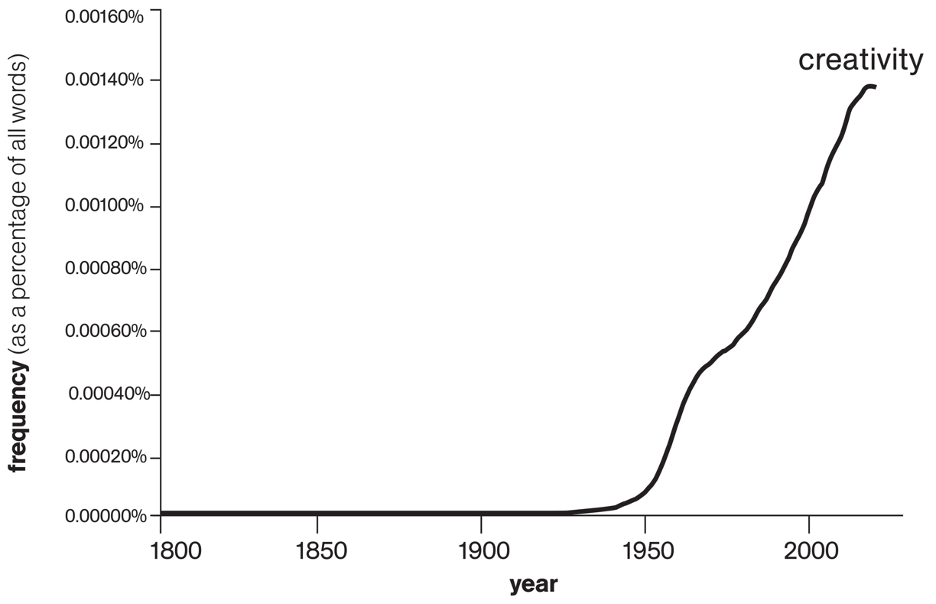
In particular, it became popular among the professions: researchers, psychologists, designers, public relations, and various consultants. Franklin’s work shows that an underlying anxiety of the Cold War was the fear of the stagnating conformity that was defining the Soviet Union. Viewed as a strength in the USSR, for the land of freedom and capitalism, it was a nightmare. Researchers began to become obsessed with the idea of the innovative individual, pioneering entrepreneurs who could rise up to create technology to defeat the Russians. A perfect match was made between psychological testing used to foster creative identities and economic imperatives to compete with communism. The idea was seductive, and it spread.
So who’s right? According to the data, it’s Franklin. The term simply did not exist 100 years ago. And once you realize this, you can see this usage everywhere from magazines to newspapers to apple ads to water bottles. To be creative is to “think different,” to stand out from the crowd because you are able to tap into something special that others are not. It became so popular that sociologists like Richard Florida thought that this new class would save the country from political division. We saw how well that went.
But the term creative has existed for a long time, since at least the early 15th century, its root from the Latin creatus. This is what Leski is tapping into in her work; that is the deeply human ability to make something out of nothing. It’s at the core of not only design, but all productive work. For me this is what makes certain kinds work truly creative. It’s not that various jobs are distinctly artsy or unique, but that they produce something of value to society. Teachers are creative when they make inspiring lesson plans, just like how car mechanics are creative when they repair an engine.
But when ideas become commodified, they lose their ability to serve people broadly and instead become subjected to the whims and pressures of the market. I know many designers and others who want nothing more than to be creative in this way, but feel compelled to be something else, whether because they need to provide for themselves or they’re being told so. They might want to do something productive, but since the victory of capitalism in 1989, these kinds of jobs have dwindled each year. More paper pushing, less paper making. Rather than becoming more accessible, creative work has narrowed, and the competition for it has intensified. It is this marketization that has given creativity the appearance of something special, the generated scarcity reinforcing its mythologized origins.
That’s why for me this is one of the most important questions we’re facing. With the rise of bullshit jobs and dumb AI slop, we’re seeing an escalating crisis of creativity. If to be creative is to be human, what are the implications in a world with productive machines and unproductive people? Rather than making creativity more scarce, we should make it more available. The challenge is how to make it happen.
References